
Artist Spotlight: Wing Lam Chan’s Borrowed Absurdity
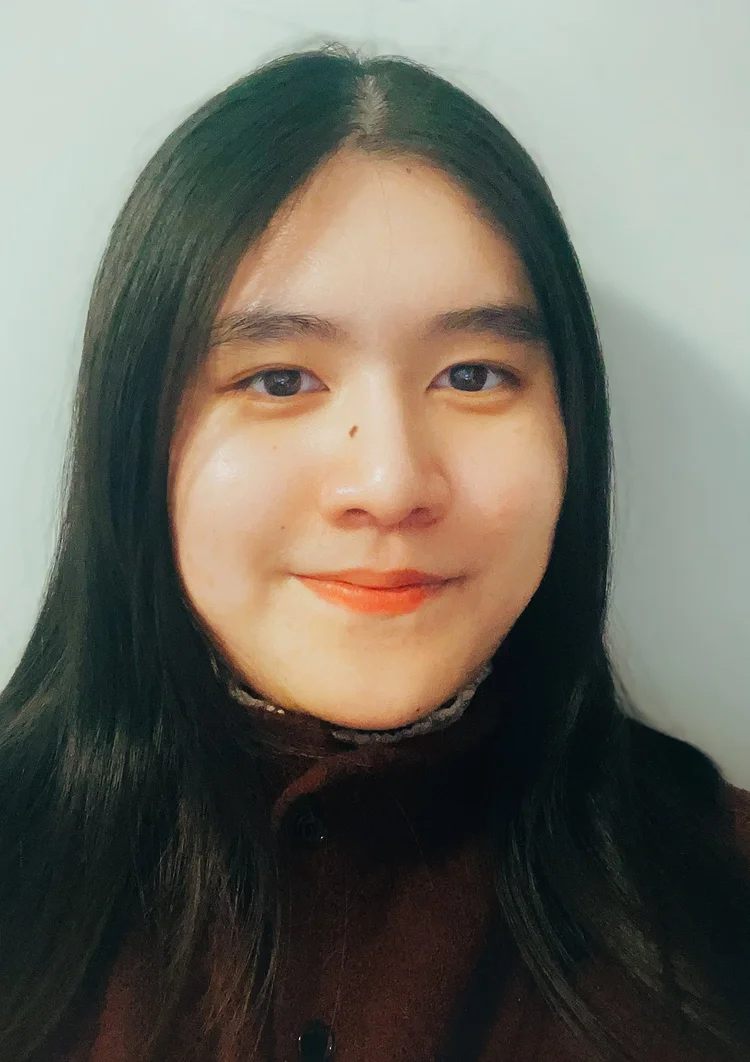
by Wing Lam Chan for The 44 North, Guest Writer
“Where are you from?”
A typical icebreaker question that everyone comes across.
My only answer would be “Hong Kong,” since I was born and raised there. Period. However, my identity tends to be flattened in a sentence—“So you’re from China”—if the questioner is not familiar with Hong Kong’s historical dynamics or holds a political stance. I always feel a need to justify my identity in this unilateral box; likewise, I’m gagged with papers and evidence that state Hong Kong is a special administrative region of China. The simple question becomes a drowning debate.
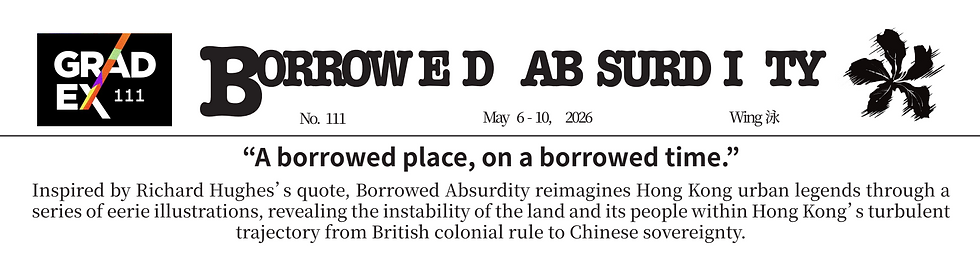
Speaking has never been my strength, but drawing is. So, on faith and belief, I propelled myself with a stylus pen in the ocean, exploring the fragmented storytelling of local identity. Eventually, I came up with seven eerie illustrations that reimagine Hong Kong urban legends—Borrowed Absurdity.

The title Borrowed Absurdity comprises two elements: The impermanence throughout Hong Kong’s trajectory and urban legends. The term “borrowed” is inspired by the quote from Richard Hughes that describes Hong Kong’s uncertain socio-political landscape between 1960 and 1970:
“A borrowed place, on borrowed time.”
The quote captures the city as a fragmented land amid temporary colonial existence since 1841: The British occupied both Hong Kong Island and Kowloon, and for 99 years, obtained a lease of the New Territories, later interrupted by Japanese occupation for three years and eight months. Although Hong Kong was transferred to Chinese sovereignty and established as a Special Administrative Region in 1997—with the exercise of “One country, two systems” maintaining its own capitalist economy, legal system, education and language—this autonomy will expire in 2047. The land perpetuates “borrowed,” and so do the social anxieties embedded within it.
Interestingly, urban legends also possess such instability, with their doubtful credibility and evolving versions of the story often intended for thrilling entertainment or warning about certain behaviours across time. By recontextualizing them and layering the collective fear with historical backdrops, Borrowed Absurdity aims to initiate discourse on identity, precarity and resistance against assimilation.
The Braid Girl & The Ghost Postman

The series begins with a dual nightmare shared by Mainland refugees and the local community. During the 60s, struggle sessions emerged within the Chinese Communist movement’s “Great Leap Forward.” Farmers were mandated to undertake industrial work and lost autonomy over their land, leading to severe famine and deaths by persecution. Meanwhile, Hong Kong was not only under British colonial rule, but regarded as one of the most prosperous cities. To attract more cheap labour, the British Hong Kong government pitched the “Touch Base” Policy—an immigration policy that grants residency to Mainlanders who successfully reached the city. Countless Mainlanders were sent running across a risky baseball field towards the life-changing base called Hong Kong, often on moving trains. The Braid Girl demonstrates this plight. Braiding her hope towards the escape, the braid becomes her stumbling block—a force that motivates her while distorting her body. As it tightens against the moving train, her face is split in two, and with it, her imagined future and possibilities collapse.

The tragedies continue to fall upon local communities. Hong Kong has faced prolonged overpopulation since World War II, aggravated by the influx of Mainland refugees under the “Touch Base” Policy. With rising social tension, the seeds of fear and antipathy were sown, marking the expanding division between locals and outsiders in the future. While The Braid Girl reflects the refugee’s tragic experiences, The Ghost Postman shifts to a local perspective, depicting the suppressed, collective anxiety of overpopulation. The postman, as an embodiment of the outsider, slips through the gates and grates the community’s nerves alongside increasing death and disaster.
The Haunted School & The Convenience House

As someone born under Chinese sovereignty, I always feel distant from British colonization and Japanese occupation. The history is either compressed into a list or neglected in education, not to mention the disappearing Indigenous people (Punti, Hakka, Tanka, and Hoklo) in rural New Territories. Land, to Indigenous people, is not only property but also a means of preserving lineage, fengshui, and sustained livelihoods. They maintained village autonomy under the Chinese imperial system, yet foreign rulers took over their land rights against the traditional practice, provoking counterattacks such as the Six-Day war. Confronted by well-trained troops with advanced weapons, hundreds of native people were sacrificed; their deaths remain unrecorded, fading within their own land and memory. In contrast to the legends of Tat Tak School, which relate to malevolent spirits or the deadly consequences of adventurers, The Haunted School examines haunting in a decolonial framework. As the spirits return to school and collect their own desks, their contours consolidate gradually, reclaiming their presence throughout historical erasure in the classroom setting.

The unstable land once failed to preserve the home for Indigenous New Territories inhabitants; nevertheless, becomes a lifelong shelter for others. The Convenience House is set in Tai O, a traditional fishing village inhabited by Tanka people and well known for its stilt houses above water. Located in the Pearl River Estuary where it meets the South China Sea, it also became a migration passage for Mainlanders crossing the water during the Cultural Revolution. Unlike the scenic stilt houses, “The Convenience House”—a single-story, tiled-roof hospice— hides in the shadows and is lived in by dying elders, often those whose bodies were refused repatriation by their families due to taboo. Amid flowing water and life, the “Convenience House” becomes a rigid support for the drifting man, as if a tilapia adapting to new water and becoming part of nature after death among local fisheries. This portrays an inexplicable calm settling upon unstable land shaped by a sojourner mentality.
The Mah-jong Demise & The Parallel Station


The year 1984 marked a significant milestone in Hong Kong—the UK and China signed the Sino-British Joint Declaration, marking the end of 156 years of British colonial rule and the handover to Chinese sovereignty in 1997. Hongkongers had no say in the decision. Witnessing the influences of the Chinese Communist Party, rather than celebration, Hong Kong society was rampant with mistrust and disappointment towards the decision. Irreversible fate and stillness is depicted in both The Mah-jong Demise and The Parallel Station—either extending time through indulgence in gambling and drugs, or travelling on a Möbius track with contradictory directional signs, everything lost in directions but a gloomy future. Authority over land and life persists across time.
The Submerging Turtle

A visitor asked me, “Shouldn’t the turtle be happy as it returns to the ocean where it belongs?” Ideally, yes, only if the ocean has not been contaminated. Since the 1997 handover, conflicts between Hong Kong and China have been intensified through repressions of culture, economy, politics, and the legal system. Back in elementary school, I remember that Putonghua (standard Beijing Mandarin) was taught as the medium in Chinese Language Education, dividing students into two groups: Putonghua applied to the “elite” class, while Cantonese (the primary spoken language in Hong Kong) was for the “academically inferior” one. Following perpetual measures on the Hong Kong-Mainland relationship and demonstrations, including the 2014 Umbrella Revolution and the 2019 Anti-Extradition Law Amendment Bill Movement, the Chinese government ultimately decided to silence the crowd with national security laws that erode freedom of speech. Throughout the decades, from ripple to rogue wave, from language to internal affairs, Hong Kong was dragged toward assimilation in stages. If they abide by the “One Country, Two Systems” promise and respect the dynamic Hong Kong identity, I believe Hongkongers will feel less reluctant to embrace this “mother ocean.”

Borrowed Absurdity presents assembled fragments of Hong Kong lived experience rather than a map of Hong Kong’s history or a complete portrait of Hongkongers, often featuring Mainlanders, spirits/creatures, and distorted space. Shaped by the fusion of Chinese and Western influences, Hong Kong identity suggests a sense of fluidity. It’s not about ethnicity or holding residency but about adapting the language and shared values. If you called Hong Kong home, you are a Hongkonger.
The series ends, but my story certainly doesn’t. Perhaps it offers an entrance to the far shoreline before people dive into the water. Perhaps the landscape has changed beyond recognition before people get to know it. Never will submersion be the final ending for Hong Kong—hope floats, always through collective storytelling.
About Wing Lam Chan

Wing Lam Chan (泳 Wing (@lamc_illust)) is a Hong Kong digital illustrator based in Toronto and a recent graduate of the Illustration (BDES) program at OCAD University.
Wing’s practice blends Eastern and Western storytelling through editorial and sequential illustration, using symbolism and emotional narratives to explore themes of culture, identity, and memory. She is drawn to the quiet moments embedded in everyday life, visualizing them through a surrealist art style. Wing believes storytelling can amplify community voices, reconstruct marginalized narratives, and foster empathy and shared humanity.


Comments