top of page

by Catherine Mwitta for The 44 North, Contributing Writer - Politics


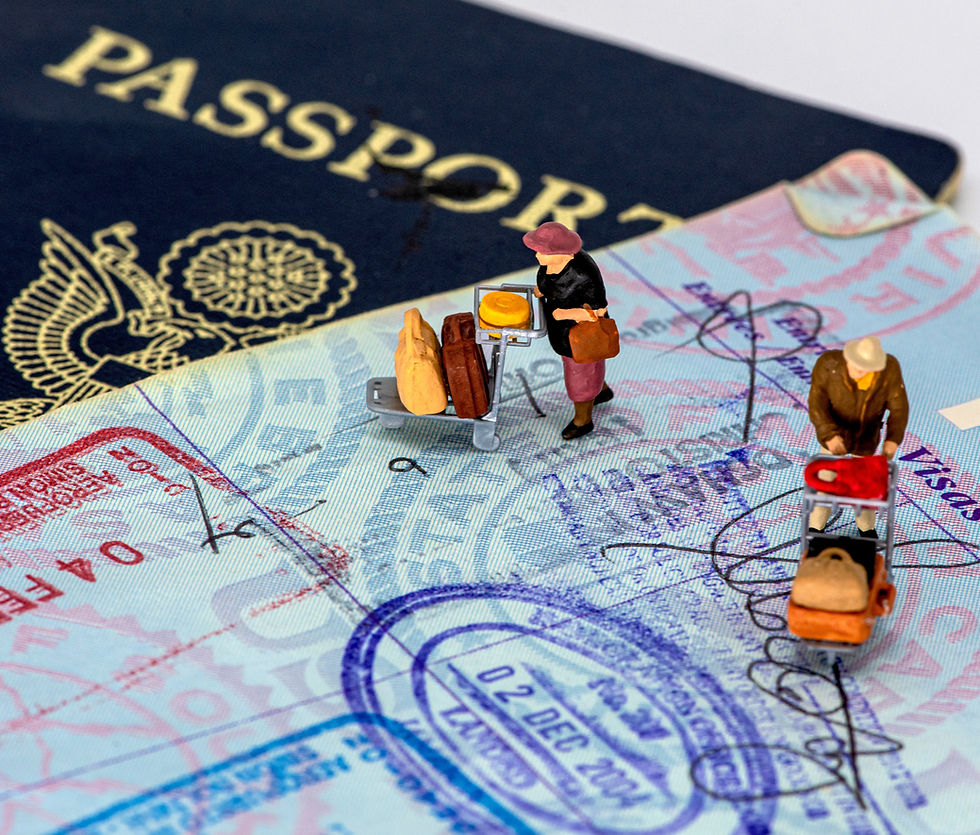
An artistic rendering of immigration via figurines walking across stamped passports while pushing suitcase trolleys.

Editor's Note:


The following article reflects the views & analysis of the author. As with all opinion and essay submissions, the piece has been edited for clarity and reviewed carefully for factual accuracy, but the interpretations & arguments are the author’s own. The 44 North publishes an array of perspectives & voices to encourage and ensure thoughtful engagement with complex social, political, historical, and cultural issues.


As Canada faces a cost-of-living crisis, politicians are reviving a long history of blaming newcomers—this time, targeting international students. 


In 1869, the Canadian Immigration Act discriminated against immigrants on the grounds of class and disability. The federal government enacted further measures to restrict Chinese immigration, including a head tax and the Chinese Immigration Act of 1923. Additional racial and national restrictions were introduced after the First World War: Under a revised Immigration Act in 1919, the government excluded specific groups from entering the country, including Communists, Mennonites, Doukhobors, and other groups with particular religious practices, such as Judaism, as well as nationalities whose countries had fought against Canada during the First World War, such as Austrians, Hungarians, and Turks. 


Via The Canadian Encyclopedia: Southeast Asian refugees at CFB Griesbach Military Base in Edmonton, August 1979. Photo: © Murray Mosher. Courtesy of The Canadian Immigration Historical Society.

Until 1976, it seemed immigration in Canada was largely an “open door” policy privileging whiteness and interest in Western Canada settlement. Changes to prior immigration policies occurred to address severe labour market shortages and adjust to shifting global demographics. As Canada’s economic goals expanded, immigration policy evolved to include multicultural policy embedded in the Canadian Charter of Rights and Freedoms in 1982 and again in 1988 via the Canadian Multicultural Act. Both have promoted economic growth by increasing the labour supply while promising strong human rights and safety guarantees for newcomers from diverse backgrounds. Over time, the demographics of immigrants arriving in Canada shifted from largely British and Western European to Asian (Indian, Filipino, Chinese).


Over thirty-five years later, 2024 saw the highest levels of immigration in over a decade. 483,390 new permanent residents arrived in Canada, and approximately 292,970 new international students received permits. At the same time, housing and healthcare issues within the country came to a head. 


Long wait times in hospital emergency rooms and the shortage of family doctors are among the many issues the Canadian healthcare system faces, which have led to worsening patient outcomes. Similarly, rent prices in Canada rose 5.9 percent in 2024 compared to 2023. The Toronto metropolitan area, in particular, saw an overall 5.1 percent increase in rent for two-bedroom units, from $2,560 in the first quarter of 2019 to $2,690 in the first quarter of 2025. 


Canadians have raised concerns about the cost of living and quality of life with their members of parliament. During Canada’s last federal election and in its wake, both Conservative and Liberal politicians have used these pain points as campaign guideposts. This isn’t unusual, but something is different this time: Several mostly Conservative leaders and MPs have positioned international students as the main reason for their concerns. 


Immigration Minister Marc Miller and Ontario Premier Doug Ford have both placed blame for the rapid growth in international student enrollment on private colleges, with the federal Liberal Party going so far as to announce a cap on international student enrollment from 2025 to 2027. Further, according to the Centre of Excellence of the Canadian Federation, there has been a sharp rise in anti-immigration sentiment across all age groups in Canada. Online rhetoric, such as from notable TikTokers, is stoking anti-immigrant views. 


The Eye Opener, a Toronto Metropolitan University Newspaper, interviewed South Asian international students about the rise of xenophobia in Canada. Aasim Ul Haq Khwaja, a second-year business technology management student, said the first thing his family asks him when they call is whether he feels safe. Priyanka Prakash, a third-year food and nutrition student, and Harshi Shah, another third-year nutrition and food student, both said phone calls back home predominantly consist of family members asking about their safety in Toronto. 


Between 2020 and 2023, police in the Waterloo region logged 387 race-based hate crimes, with a significant increase in incidents targeting South Asians as international student numbers simultaneously surged. In 2023 alone, South Asians accounted for one in six reported race-based hate crimes, up from one in ten the previous year. Most of these crimes involved threats or graffiti, but 12 percent escalated to physical assault.


Via Waterloo Regional Police Service

Meanwhile, in Ontario—the province with the second-highest cost of living—the Conservative Party plans to remove rent control, has expanded funding for private clinics to 300 times that of public hospitals, and has changed OSAP policies in favour of loans rather than grants, reducing post-secondary affordability. Politicians and government officials have yet to take accountability here. Hypothetically, if the influx of international students and immigrants is too great for our healthcare, living, and education systems, then there’s still a vital distinction to make: This is most likely a government policy failure, not necessarily the fault of international students and immigrants.


Whenever a country faces systemic failures, it’s easy to use immigrants as a tool to either bolster the economy or excuse governmental failures. Canada is no different, despite the “goodwill” pedestal it tends to stand on, courtesy of its proximity to the more overt anti-immigration practices in the US. International students have long been used as “cash cows” for underfunded public and private universities and colleges, especially in Ontario. They’ve worked jobs no one else wanted, particularly under-the-table jobs, which frequently resulted in unfair treatment and abuse in the workplace. Yet, amid rising housing prices and the cost of living rising exponentially each year, politicians seem more desperate, and therefore, more apt to use international students as scapegoats instead of repealing harmful policies. 


Currently, the federal government is looking to launch a new cap on international students by 2027. These sentiments were reinforced by King Charles and Prime Minister Mark Carney. As Canada continues to dismiss or ignore systemic issues within its society, the blame is bound to shift to another. 

Catherine Mwitta has a bachelor’s in creative writing from Kwantlen Polytechnic University and a certification in Journalism from Langara College. She is an editor at Augur Magazine and INKspire. Likewise, bylines at Stir Vancouver, SAD Mag, This Magazine, C Magazine and Bluffs Monitor.


by Wing Lam Chan for The 44 North, Guest Writer


“Where are you from?”


A typical icebreaker question that everyone comes across.


My only answer would be “Hong Kong,” since I was born and raised there. Period. However, my identity tends to be flattened in a sentence—“So you’re from China”—if the questioner is not familiar with Hong Kong’s historical dynamics or holds a political stance. I always feel a need to justify my identity in this unilateral box; likewise, I’m gagged with papers and evidence that state Hong Kong is a special administrative region of China. The simple question becomes a drowning debate.


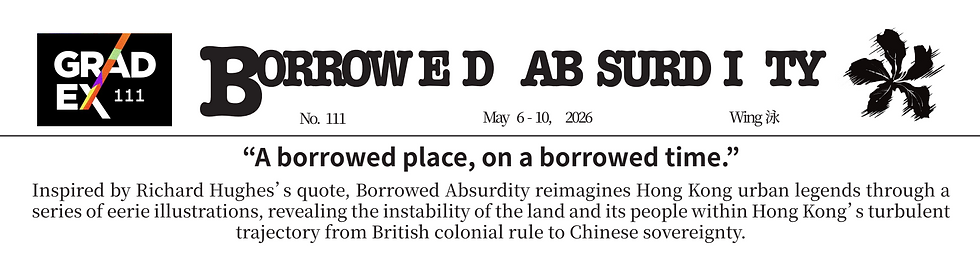
Speaking has never been my strength, but drawing is. So, on faith and belief, I propelled myself with a stylus pen in the ocean, exploring the fragmented storytelling of local identity. Eventually, I came up with seven eerie illustrations that reimagine Hong Kong urban legends—Borrowed Absurdity.


Wing at GradEX, next to her collected work, Borrowed Absurdity

The title Borrowed Absurdity comprises two elements: The impermanence throughout Hong Kong’s trajectory and urban legends. The term “borrowed” is inspired by the quote from Richard Hughes that describes Hong Kong’s uncertain socio-political landscape between 1960 and 1970: 


“A borrowed place, on borrowed time.” 


The quote captures the city as a fragmented land amid temporary colonial existence since 1841: The British occupied both Hong Kong Island and Kowloon, and for 99 years, obtained a lease of the New Territories, later interrupted by Japanese occupation for three years and eight months. Although Hong Kong was transferred to Chinese sovereignty and established as a Special Administrative Region in 1997—with the exercise of “One country, two systems” maintaining its own capitalist economy, legal system, education and language—this autonomy will expire in 2047. The land perpetuates “borrowed,” and so do the social anxieties embedded within it.


Interestingly, urban legends also possess such instability, with their doubtful credibility and evolving versions of the story often intended for thrilling entertainment or warning about certain behaviours across time. By recontextualizing them and layering the collective fear with historical backdrops, Borrowed Absurdity aims to initiate discourse on identity, precarity and resistance against assimilation.


The Braid Girl & The Ghost Postman


The Braid Girl by Wing Lam Chan: It is said that the long-braided spirit was once a rural girl fleeing from mainland China to Hong Kong. Driven by the immigration policy, she tied her Hong Kong dream into her braid and boarded a train toward the city. Mistaking a passing station for the final stop, she abandoned everything behind and jumped prematurely. Her reckless leap marked the tragic end of her journey.

The series begins with a dual nightmare shared by Mainland refugees and the local community. During the 60s, struggle sessions emerged within the Chinese Communist movement’s “Great Leap Forward.” Farmers were mandated to undertake industrial work and lost autonomy over their land, leading to severe famine and deaths by persecution. Meanwhile, Hong Kong was not only under British colonial rule, but regarded as one of the most prosperous cities. To attract more cheap labour, the British Hong Kong government pitched the “Touch Base” Policy—an immigration policy that grants residency to Mainlanders who successfully reached the city. Countless Mainlanders were sent running across a risky baseball field towards the life-changing base called Hong Kong, often on moving trains. The Braid Girl demonstrates this plight. Braiding her hope towards the escape, the braid becomes her stumbling block—a force that motivates her while distorting her body. As it tightens against the moving train, her face is split in two, and with it, her imagined future and possibilities collapse. 


The Ghost Postman by Wing Lam Chan: It is said that a ghostly postman unlocked gates and slipped blank letters into the Wan Chai neighbourhood. Those who receive the letters are doomed to die within days. As death accumulates, fear seeps into restless nights.

The tragedies continue to fall upon local communities. Hong Kong has faced prolonged overpopulation since World War II, aggravated by the influx of Mainland refugees under the “Touch Base” Policy. With rising social tension, the seeds of fear and antipathy were sown, marking the expanding division between locals and outsiders in the future. While The Braid Girl reflects the refugee’s tragic experiences, The Ghost Postman shifts to a local perspective, depicting the suppressed, collective anxiety of overpopulation. The postman, as an embodiment of the outsider, slips through the gates and grates the community’s nerves alongside increasing death and disaster. 


The Haunted School & The Convenience House


The Haunted School by Wing Lam Chan: It is said that the abandoned Tat Tak School is haunted by spirits of Indigenous New Territories inhabitants killed by British and Japanese troops. Buried within a nearby mass grave, they wander through the ruined classrooms searching for their seats among nameless gravestones and rubble.

As someone born under Chinese sovereignty, I always feel distant from British colonization and Japanese occupation. The history is either compressed into a list or neglected in education, not to mention the disappearing Indigenous people (Punti, Hakka, Tanka, and Hoklo) in rural New Territories. Land, to Indigenous people, is not only property but also a means of preserving lineage, fengshui, and sustained livelihoods. They maintained village autonomy under the Chinese imperial system, yet foreign rulers took over their land rights against the traditional practice, provoking counterattacks such as the Six-Day war. Confronted by well-trained troops with advanced weapons, hundreds of native people were sacrificed; their deaths remain unrecorded, fading within their own land and memory. In contrast to the legends of Tat Tak School, which relate to malevolent spirits or the deadly consequences of adventurers, The Haunted School examines haunting in a decolonial framework. As the spirits return to school and collect their own desks, their contours consolidate gradually, reclaiming their presence throughout historical erasure in the classroom setting.


The Convenience House by Wing Lam Chan: It is said that an unsettling hospice lies hidden among the stilt houses in Tai O, once serving as a burial site for dying elders whose bodies were never reclaimed by their families. Within this dreadful space, an elderly man rests while imagining himself as a tilapia—an invasive species brought from the Mainland—drifting among the local fisheries of the village.

The unstable land once failed to preserve the home for Indigenous New Territories inhabitants; nevertheless, becomes a lifelong shelter for others. The Convenience House is set in Tai O, a traditional fishing village inhabited by Tanka people and well known for its stilt houses above water. Located in the Pearl River Estuary where it meets the South China Sea, it also became a migration passage for Mainlanders crossing the water during the Cultural Revolution. Unlike the scenic stilt houses, “The Convenience House”—a single-story, tiled-roof hospice— hides in the shadows and is lived in by dying elders, often those whose bodies were refused repatriation by their families due to taboo. Amid flowing water and life, the “Convenience House” becomes a rigid support for the drifting man, as if a tilapia adapting to new water and becoming part of nature after death among local fisheries. This portrays an inexplicable calm settling upon unstable land shaped by a sojourner mentality.


The Mah-jong Demise & The Parallel Station


The Mah-jong Demise by Wing Lam Chan: It is said that four gamblers died while playing mah-jong after forming four tiles with the character “West” (which sounds similar to “death” in Chinese).

The Parallel Station by Wing Lam Chan: It is said that a salaryman became trapped within the same station on his journey home, as if he had entered a parallel world.

The year 1984 marked a significant milestone in Hong Kong—the UK and China signed the Sino-British Joint Declaration, marking the end of 156 years of British colonial rule and the handover to Chinese sovereignty in 1997. Hongkongers had no say in the decision. Witnessing the influences of the Chinese Communist Party, rather than celebration, Hong Kong society was rampant with mistrust and disappointment towards the decision.  Irreversible fate and stillness is depicted in both The Mah-jong Demise and The Parallel Station—either extending time through indulgence in gambling and drugs, or travelling on a Möbius track with contradictory directional signs, everything lost in directions but a gloomy future. Authority over land and life persists across time.


The Submerging Turtle


The Submerging Turtle by Wing Lam Chan: It is said that a giant turtle deity lives within the mountains and descends gradually each year. Once it reaches the sea, the city will collapse into a violent red ocean.

A visitor asked me, “Shouldn’t the turtle be happy as it returns to the ocean where it belongs?” Ideally, yes, only if the ocean has not been contaminated. Since the 1997 handover, conflicts between Hong Kong and China have been intensified through repressions of culture, economy, politics, and the legal system. Back in elementary school, I remember that Putonghua (standard Beijing Mandarin) was taught as the medium in Chinese Language Education, dividing students into two groups: Putonghua applied to the “elite” class, while Cantonese (the primary spoken language in Hong Kong) was for the “academically inferior” one. Following perpetual measures on the Hong Kong-Mainland relationship and demonstrations, including the 2014 Umbrella Revolution and the 2019 Anti-Extradition Law Amendment Bill Movement, the Chinese government ultimately decided to silence the crowd with national security laws that erode freedom of speech. Throughout the decades, from ripple to rogue wave, from language to internal affairs, Hong Kong was dragged toward assimilation in stages. If they abide by the “One Country, Two Systems” promise and respect the dynamic Hong Kong identity, I believe Hongkongers will feel less reluctant to embrace this “mother ocean.”


Borrowed Absurdity by Wing Lam Chan

Borrowed Absurdity presents assembled fragments of Hong Kong lived experience rather than a map of Hong Kong’s history or a complete portrait of Hongkongers, often featuring Mainlanders, spirits/creatures, and distorted space. Shaped by the fusion of Chinese and Western influences, Hong Kong identity suggests a sense of fluidity. It’s not about ethnicity or holding residency but about adapting the language and shared values. If you called Hong Kong home, you are a Hongkonger.


The series ends, but my story certainly doesn’t. Perhaps it offers an entrance to the far shoreline before people dive into the water. Perhaps the landscape has changed beyond recognition before people get to know it. Never will submersion be the final ending for Hong Kong—hope floats, always through collective storytelling.


About Wing Lam Chan

Bio Portrait by Wing Lam Chan

Wing Lam Chan (泳 Wing (@lamc_illust)) is a Hong Kong digital illustrator based in Toronto and a recent graduate of the Illustration (BDES) program at OCAD University.


Wing’s practice blends Eastern and Western storytelling through editorial and sequential illustration, using symbolism and emotional narratives to explore themes of culture, identity, and memory. She is drawn to the quiet moments embedded in everyday life, visualizing them through a surrealist art style. Wing believes storytelling can amplify community voices, reconstruct marginalized narratives, and foster empathy and shared humanity.


by Sylphia Basak for The 44 North, Contributing Writer - Politics


Editor's Note:


The following article reflects the views & analysis of the author. As with all opinion and essay submissions, the piece has been edited for clarity and reviewed carefully for factual accuracy, but the interpretations & arguments are the author’s own. The 44 North publishes an array of perspectives & voices to encourage and ensure thoughtful engagement with complex social, political, historical, and cultural issues.


"Those who wish to dismantle Canada’s systemic complicity in the neocolonial world order must first understand the intricacies of how we uphold it. Especially as American fascism continues to socially, politically, and literally encroach on this side of the border."

Ahead of the FIFA World Cup, Toronto officials have unveiled a new $12.5-million police command centre—the ‘centrepiece’ of the city’s security plans for the FIFA World Cup (CBC). Other ornamentations of this new city arrangement ahead of the World Cup include a counter-terrorism unit, stationed with semi-automatic rifles at ‘key locations,’ though they don’t point to any specific ‘threat’ spurring this new wave of enforcement.


Photos of armed guards stationed in Toronto with semi-automatic rifles (CBC). 
ICE via CBC
ICE via CBC

Most controversially, there have been reports and public concern around possible Immigration and Customs Enforcement (ICE) officers patrolling Toronto during the World Cup, despite an official motion by Mayor Olivia Chow and the Toronto City Council to keep ICE out of the city.  It has been stated that officers will not be armed, however, many local government members and police accountability & immigration justice organizations are (rightfully) sounding the alarm given ICE’s record of enacting violence towards civilians, amid a stark uptick in fatalities and imprisonments. 


Many Canadians remain unaware that ICE, through Homeland Security Investigations, lists offices in five Canadian cities—Calgary, Montreal, Ottawa, Toronto, and Vancouver—operating out of U.S. embassy or consular locations. While ICE says their officers do not carry firearms or conduct arrests in Canada, their presence has raised serious concern among immigration justice advocates and elected officials. The Canadian government has done little to condemn the American administration’s use of ICE, amid documented allegations of abuse, including pregnancies of women and children in ICE detention centres ,  wrongful detentions, and excessive force and deaths in and out of custody, including the well-publicized deaths of  Renee Good, Alex Pretti and Keith Porter Jr. According to several reports, Canadian banks and pension funds, including the Canada Pension Plan (CPP), the Ontario Teachers’ Pension Plan, the Caisse de dépôt et placement du Québec, and Desjardins  have poured up to $35 billion into ICE contractors (COOP Media NB). Canadian collusion with ICE trickles down to even their armored trucks, an entire fleet of which have been manufactured by Canadian security transport company, Roshel, based in Brampton, Ontario, who have also invested in manufacturing armoured trucks for the Israeli government.  


Hannah Arendt’s concept of “The Banality of Evil,” was written about Adolf Eichmann, who participated in the January 1942 Wannsee Conference where the implementation of the genocidal Final Solution to the Jewish Question was planned. Eichmann was also responsible for the logistics involved in the mass deportation of millions of Jews to Nazi ghettos and extermination camps across German-occupied Europe. Despite the horrific, deep-seated systemic violence of Eichmann’s crimes, in observing him, Arendt describes a type of villainy not necessarily born entirely out of malice or sadism, but out of apathy toward others and a hyper-individualist need for power and status. A key point made by Arendt was that this was not a particularly exceptional type of evil; one would only have to convince themselves that they’re doing right by themselves and perhaps their fellow countrymen, to excuse atrocities committed under their leadership. 


Adolf Eichmann standing trial (Wikipedia)

Hannah Arendt was, throughout her life, a Zionist to varying degrees. And I understand the irony in using a framework created by her to understand the psyche of those complicit in Israel’s genocide of Gaza—especially since the trial she uses as a case study takes place on occupied Palestinian territory. In her later years, including post WWII, she became critical of evolving Zionism, arguing against collaboration with imperial powers, and that the implementation of a Jewish-only state would cause unnecessary conflict in the West Asian region. Though I disagree deeply with much of her rhetoric in this regard,  I feel hers is an appropriate and timely lens through which to look at the Canadian weapons industry and even at Arendt herself. As a reader, however. take her words (and mine) with a grain of salt. 


But, there’s  an argument to be had that this school of thought—which plagued Eichmann and his subordinates—captures something within the core ethos of Canadian politics, and perhaps explains our government’s willingness to continually partake in an increasingly fascist system alongside its more abrasive front-facing figures. 


Despite Canada’s global reputation for placidity, in addition to this country’s lengthy history of mass violence toward our Indigenous people and ethnic minorities who immigrated here, Canada has also made extensive contributions to the military industrial complex of Western nations.  


“Canada is certainly almost always ranked in the top 15 by volume of sales but that [ranking] is actually problematic for a number of reasons. One reason is that a number of groups that measure these things only count complete weapons systems, for example the Stockholm International Peace Research Institute, or SIPRI. A lot of what Canada produces is in the form of components or subsystems. Also, there tends to be an undervaluing of Canada’s involvement in the trade because nobody has any idea of the volume of our trade with the United States.” 


Despite the recent disintegration of free-trade between Canada and the U.S., this government appears to still engage in a frequent flow of imports and exports when it comes to military weapons. Canada’s main weapons export to the U.S. and subsequently any U.S. proxies, being parts for the F-35 fighter jet. However, several factories covertly include weapons parts in their inventory. And despite the Canadian government's official statements, these weapons parts still find their way to the assembly line of Israeli weapons, where they’re used to carry out genocide, as concluded by Amnesty International and testified by South Africa before the ICJ, as well as reflected in the ICJ's provisional measures.


Image from Arms Embargo Now

The  Arms Embargo Now coalition has published reports and evidence suggesting the government of Canada continue to have its hands in weapons manufacturing. Specifically, in facilitating the genocidal occupation of Gaza and the rest of Palestine, despite the Canadian government having claimed to ban all exports to Israel. Global Affairs Canada disputes several of those claims, calling them misleading, but the report has further intensified scrutiny of Canada's military-export regime and its loopholes.


Mélanie Joly, Minister of Industry of Canada via CBC. 

In 2024, the Canadian Government announced it would no longer be selling weapons directly to Israel, Anita Anand, Foreign Affairs Minister is quoted as saying;


“Canada has drawn, and will continue to draw, a hard line: since January 2024, we have refused any new permits for controlled goods that could be used in Gaza. Not one has been approved…We went further by freezing all existing permits in 2024 that could have allowed military components to be used in Gaza, and those permits remain suspended today. The law is clear: no company may export controlled goods without a valid permit. We will not hesitate to ensure that those who violate this law face legal consequences that include fines, seizures and criminal prosecution. In other words, we will not allow Canadian-made weapons to fuel this conflict in any way.” After examining the report released on July 29, 2025, Global Affairs Canada officials have determined that a number of claims in the report are misleading and significantly misrepresent the facts…“Canada continues to deny any export permits for materials that could be used in Gaza…


We take any allegations of circumventing of Canada’s export regime very seriously and, if true, these would be accompanied by severe legal sanctions.”


Anita Anand, Minister of Foreign Affairs (CBC)

However, the Arms Embargo report reveals several contradictions in statements made by members of the Canadian government, who have persistently denied their continued involvement in arms manufacturing.


According the report’s findings;

  • 421,070 bullets were exported to Israel since the Gaza assault began, including one shipment in April 2025 alone containing 175,000 bullets;

  • Three shipments of cartridges from a General Dynamics Ordnance and Tactical Systems (GD-OTS) facility in Repentigny, Quebec, including one that occurred nine days after the then-Foreign Affairs Minister publicly pledged that Canada would block munitions exports from the same Quebec company to the Israeli military; 

  • 391 shipments including bullets, military equipment, weapons parts, aircraft components, and communication devices exported from Canada to Israel between October 2023 and June 2025, according to data from the Israeli Tax Authority (ITA)—representing only a portion of total exports; 

  • Shipments from seven Canadian cities destined primarily for Israel’s largest weapons company, Elbit Systems and its subsidiaries, along with other Israeli defence firms including Elta Systems, WaldyTech, Snunit Aviation and NIRON Systems;

  • Around 100 international flights transporting Canadian components to Israel—64 of them commercial passenger flights where military cargo was loaded beneath civilian travelers on routes through Frankfurt, Paris, New York, Abu Dhabi, and New Delhi.


GTA shipments to different Elbit Systems’ subdivisions and Israeli manufacturers from April 2024 to July 2025. From Arms Embargo Now. 

The data from the Israeli Tax Authority also shows that 175,000 “machine gun/handgun bullets for military use” were exported to Israel from Canada in April 2025. Since those bullets arrived, IDF soldiers and armed American mercenaries have shot and killed over a thousand Palestinians at food distribution centres.

Montreal shipments to different Elbit Systems’ subdivisions and Israeli manufacturers from April 2024 to July 2025. From Arms Embargo Now.

According to Arms Embargo Canada, Global Affairs Canada (GAC) claimed to have suspended issuing any new export permits as of January 8, 2024. That August, GAC announced they had suspended around 30 existing permits, as well as having announced the discontinuation of new permits. However, this meant that shipments of arms to Israel were still allowed to proceed under the hundreds of previously approved permits. This allows for private companies the plausible  deniability to create new contracts by selling crucial weapons parts. This loophole allowed Canadian companies to continue to profit from Israel’s genocide while the federal government misled Canadians into believing they were no longer arming Israel.


Officials then shifted their initial statement, claiming only “non-lethal” military goods are being approved for export to Israel. This extended to drone components, surveillance systems, and communications equipment. This loophole is the first of its kind, and contradicts the Arms Trade Treaty and the Export and Import Permit Act, which specifically require that officials do not approve arms transfers if they pose a substantial risk of being used in serious violations of international humanitarian law or other such abuses.  According to an inquiry conducted by The Maple, GAC was also unclear on whether the suspension of weapons’ licenses applied to Israel’s other military campaigns in Lebanon, West Bank,  Yemen, and Iran. When reached out to, they declined to comment. 


Not only are the companies that manufacture these weapons parts existing on the outskirts of major Canadian cities, many other major Canadian banks and other conglomerates have until recently acted as major investors for Israel’s largest weapons manufacturing partner, Elbit.  


Demonstrated in the above charts, manufacturing and logistics companies such as Honeywell (Mississauga),  Dishon (Vaughan), General Dynamics (Quebec) and Lockheed Martin, who have an HQ in Ottawa, ship key components of machinery directly to Elbit and other weapons companies based in Israel to form weapons of genocide  with impunity. 


New and developing  military weapons are annually advertised and demonstrated at CANSEC, Canada’s leading defense, security and emerging technology events”. This conference, which is partnered with the Canadian Department of National Defense, also has private sponsors which make up substantial portions of the Canadian economy, including Bell,  BAE systems, Raytheon and the University of Toronto. 


Comprehensive list of 2026 CANSEC sponsors.


These weapons, which are advertised as “battle-tested” in Palestine to both national and international clients, are then deployed at will to all other proxies of imperialism, from Gaza to Cuba to Sudan, to the Congo and back here on Turtle Island. Protestors of the convention have been subject to police brutality and persecution, despite it being a nonviolent action, with 12 arrested last year, including a citizen journalist.


Protestors at the 2025 CANSEC conference. From The Fulcrum and Immigrant Workers’ Centre. 
Protestors at the 2025 CANSEC conference. From The Fulcrum and Immigrant Workers’ Centre

Protestors are also said to be attending CANSEC this year which will be running from May 27-28. 


Studies from Tracking (In)Justice and Carleton University further suggest that incidents of police brutality in Canada are on the rise.


CEO and founder of Roshel, Roman Shimonov

The evidence suggests that contrary to Canada’s desired public image, this country more so acts as a transient stop—an intersection that links the imperial arms industry. And as intersected as these companies are, so too are the people who run them. Roshel, for example, the company that manufactures ICE trucks, is owned by Roman Shimonov, a Ukrainian immigrant who moved to Israel and worked in the “defense” sector. 


As uncomfortable a truth it may be, the philosophy of banal evil used by many western politicians, including those in Canada, bears a haunting resemblance to the type of banal evil used in historic fascist organizations and in men like Adolf Eichmann. Though perhaps not enacted to its absolute extreme, nonetheless the type of “banal” evil described by Arendt is still complicit in the behaviours  and actions of those who do gleefully express more extreme, genocidal intent. Too many even so-called liberals and progressives seem far too willing to toe the line, making peace with politicians who openly embrace fascist rhetoric and collude with genocidaires—so long as it benefits their career short-term. Our politicians have failed on even a base level to fully condemn the ongoing genocide Israel continues to perpetrate against Gaza, let alone impose full sanctions. Even as Israel expanded its genocidal campaign into the West Bank and Lebanon, even when Canadian citizens (foreign aid workers) were shot at and killed, and as more reports are coming out of Flotilla activists being tortured and assaulted by Israeli soldiers. And this is all despite the fact that support in Canada for the ongoing genocide is at an all time low and continues to decline.


Flotilla activists (CNN)

Our politicians not only fail to condemn, but actively aid the US in its ceaseless determination to erode the quality of life (and earth itself) for citizens in the Global South, including their own countries in exchange for lobbyists acquiring land and resources. These reports and findings at their core expose the facade of polite Canadian Liberalism. ‘Canada’ remains one of colonialism’s primary beneficiaries through loopholes and plausible deniability. And it’s precisely this that allows the Canadian government to continue to impose colonial era policy onto the Indigenous population along with other minorities. 


Those who wish to dismantle Canada’s systemic complicity in the neocolonial world order, must first understand the intricacies of how we uphold it. Especially as American fascism continues to socially, politically, and literally encroach on this side of the border. How will our communities mobilize to keep each other and visitors safe should ICE test their capacity on Canadian soil? What can we as locals do to educate others on the weapons industry in Canada and advocate for its dismantling?


When Adolf Eichmann stood trial (ironically, in Jerusalem), Hannah Arendt remarked that his demeanour, the manner with which he spoke of his involvement in the holocaust, and his architecture of some the worst war crimes seen in modern history, was that of a man describing a mundane weather event. He was not a man of the shadows, twirling a mustache and rubbing his hand with glee in delight as he sent masses of innocent people to certain death. He was a man who went to work and did his job and did it well. He only required a certain amount of cognitive dissonance to be able to justify carrying out the crimes he did. His case, and the terrifyingly similar rhetoric of our own politicians, holds up a mirror to Western citizens. It forces us to ask an ugly and uncomfortable question, one which we too often avoid—lest we face the reality of how we might align with some of the greatest most terrible war criminals of living memory; 


What do I willfully ignore on a daily basis, to be able to enjoy my day, unencumbered by the realities of what we are complicit in? 


What comfort am I willing to sacrifice, so others may live with basic rights and freedoms? 


Sylphia Basak is a journalist/writer and activist who uses a variety of mediums to convey the story she wants to tell. Her work prioritizes a decolonial lens, and seeks to counteract and analyze Western media and culture as a way of highlighting the primary contradictions of the current political climate.


bottom of page