

by Emerson Prentice for The 44 North, Contributing Writer - Politics

"Real money and time went into launching this space mission, both of which will continue to be spent as NASA progresses toward reaching its ultimate goal: Returning to the moon. The natural question is: Is it worth it? What is the actual point of an extravagant mission of this kind?"
The Artemis II mission is NASA’s next step in this generation's space race. Both the US and China have their eyes on the moon to further scientific exploration and build outposts. The Artemis mission is advancing astronomy and bringing humanity one step closer to putting humans back on the moon and exploring the cosmos.
The cost isn’t small though. The Artemis toilet alone rings in at 23 million dollars and the whole mission is over budget. These exorbitant prices hit at a difficult time for many. Inflation in the US has surged as a result of the war in Iran and affordability continues to be top of mind for Americans.
Real money and time went into launching this space mission, both of which will continue to be spent as NASA progresses toward reaching its ultimate goal: Returning to the moon. The natural question is: Is it worth it? What is the actual point of an extravagant mission of this kind?
An estimated 650 million people watched the first moon landing in July, 1969. It was a culturally iconic moment—the memories of the touchdown have echoed through generations. Young people today don’t necessarily have an equivalent moment to look upon with the same awe and wonder. Yet.
The Artemis mission has immense potential to provide this touchstone for young people right now. It may foster belief in the unknown and real faith in lofty goals—something that feels impossible to imagine in politics. The participating astronauts—Reid Wiseman, Victor Glover, Christina Koch, and Jeremy Hansen—proved that the Orion spacecraft is up to the task of returning to the moon. These astronauts pushed the needle by being the first to leave earth’s low-orbit since 1972, traveling the farthest distance humans ever have before—248,655 miles from Earth.
Viewers can now track the astronauts and spacecraft with more precise technology and a closer eye than ever before. The mission is both easy to follow and root for—it represents the advancement of not just one political party or individual but the entire human race.

In addition to building the outposts, a return to the moon has the potential to catalyze scientific advancement—a chance to explore and collect resources from the surface like helium-3. It’s also the first step in enabling humans to live on the moon in an operation similar to that of the International Space Station (ISS).
Even so, any mission to advance space exploration is a politically charged and costly one. From one angle, space is being explored and from another, it's being conquered. Building permanent outposts on the moon is not a far step from colonization.
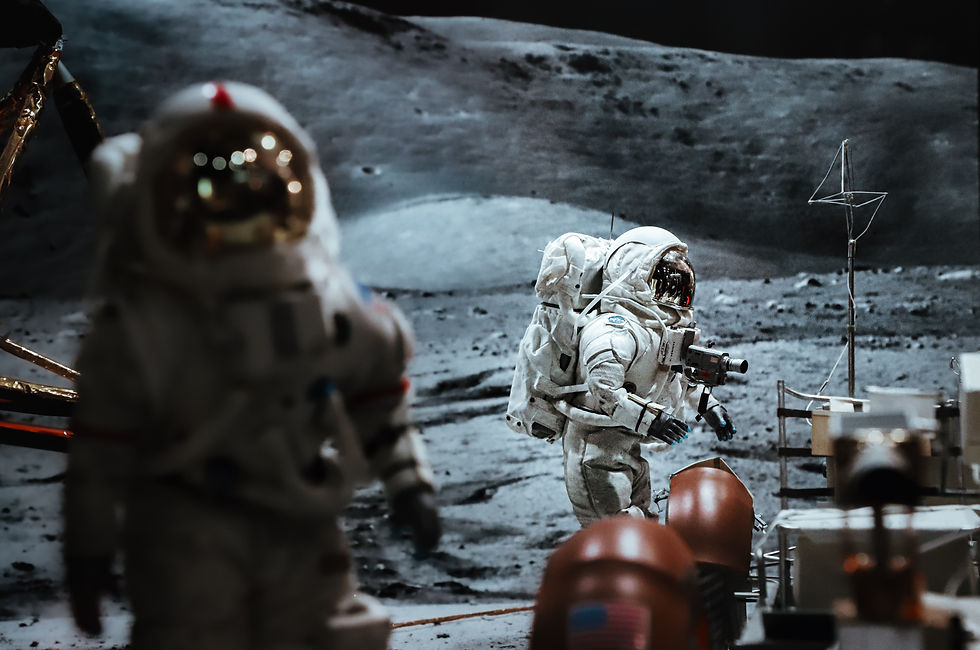
Even more, frontier research always has the potential to unveil unforeseen knowledge in its path. Pushing the boundaries of celestial research also means pushing the boundaries of research possibility as a whole.
On their trip, the astronauts witnessed parts of the Moon’s surface never before seen by human eyes. They now have experiences to share and inspire the world. Such impactful, global motivation is difficult to quantify or put a price tag on. The goals of NASA’s space exploration are certainly remote and intangible for an average American living paycheck to paycheck—images of a solar eclipse from beyond the moon won’t put food on anyone’s table—but that doesn’t mean they can’t be empowering, influential, and perhaps even make economic struggles indirectly more manageable.
The astronauts spoke of a complete shift in their world perspective upon their return to Earth.
“You guys are talking to us because we’re in a spaceship really far from Earth. But you’re on a spaceship called Earth that was created to give us a place to live in the universe, in the cosmos,” said Glover in an Interview with CBS News.
The mission has real potential to be a motivating boost for disillusioned youth. The cost is big but the payout is too—especially now. Amid a loneliness epidemic and rampant violence across the globe, unity is a necessity. This is a moment to come together and watch what humans can do with determination, teamwork, and bravery. It’s motivation toward advancements that, even though remarkably distant, can be achieved.
Artemis III, the next segment of the mission, is set for 2027 and will involve testing commercial landers. Until then, astronauts, scientists, and leaders are hard at work to make humans on the moon a reality, once again, for everyone to see.

Emerson Prentice is a Freshman at Stanford studying Anthropology. At school, she is the Campus Life desk editor for the Stanford Daily, a DJ for the campus radio station KZSU, and an associate producer for the Stanford Storytelling Project’s award-winning podcast, “State of the Human.” For fun, Emerson also loves to run, cook, and birdwatch!